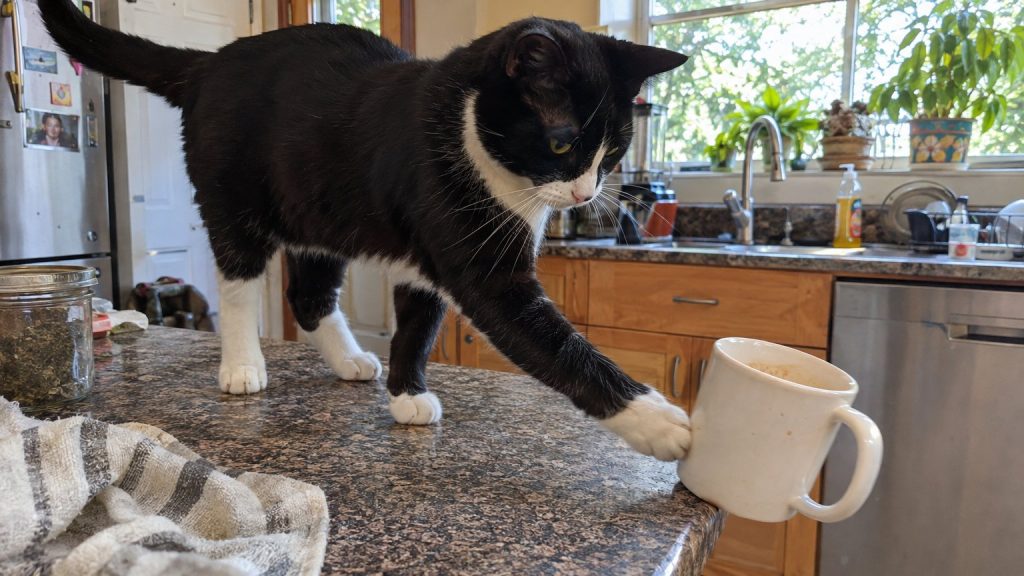
One paw. A slow push. Eye contact. And the mug goes over the edge. Every cat parent knows that look. So why do cats knock things off tables? The experts agree on one thing: it isn’t spite. It’s a mix of curiosity, instinct, and a very effective way of getting you off the sofa.
Paws Are How Cats Explore
Cats use their paws to find out about the world. Veterinary behaviorist Dr. Wailani Sung, writing for Vetstreet, says most cats start off simply curious about an object. They paw at it to see whether it moves, and how it moves, and sometimes it ends up on the floor.
Cat behavior consultant Mikel Delgado told Rover that a cat’s paw pads are very sensitive, and touching things is one way they gather information. Some objects may even feel a little like prey under the paw, which can set off play or hunting behavior.
The Fall Is the Fun Part
Once something drops, Dr. Sung says, a cat may be drawn in by the speed of the fall, the sound it makes when it lands, and the chance to chase it across the floor. For some cats, Delgado adds, knocking things off a table is simply fun, and it feels a lot like parts of a hunt.
You Always Come Running
Think about what happens after a crash. Everyone comes to look. Dr. Sung notes that some cats learn this is a reliable way to get attention, and that the louder the bang, the faster the person often arrives. Delgado says cats are quick to work out which behaviors get them what they want, even when the attention they get isn’t friendly.
A Hunter With Nothing to Hunt
Boredom plays a big part. Dr. Sung points out that cats in the wild may spend 40 to 60 percent of their time hunting for food. A cat with a full bowl and an empty day has a lot of hours to fill.
Molly DeVoss, a certified feline training and behavior specialist, told Rover that indoor cats often lack the mental stimulation and the chance to act out the hunting sequence they need, so they get creative. It may also be why so many crashes happen at night. Our guide to the 3 AM zoomies explains why cats are most active around dawn and dusk.
How to Save Your Mugs
- Clear the runway. The simplest fix is to keep light or breakable things off the surfaces your cat likes. It’s safer for your cat too, since broken glass can cut their paws.
- Close a door. If it only happens in one room, keep your cat out of that room for a while.
- Try double-sided tape. Dr. Sung says the sticky feeling on their paws puts most cats off jumping onto a table or shelf.
- Redirect, don’t punish. Instead of yelling, get your cat’s attention and give them something else to do, like chasing a toy. Rover’s experts warn that scolding can stress a cat and damage your bond.
- Give them a job. Puzzle feeders let your cat work for some of their food. Daily play with toys they can bat and chase helps too, and Delgado recommends rotating the toys so they stay interesting.
If the knocking comes with other changes in behavior, or you’ve tried everything, talk to your vet. They may refer you to an animal behavior specialist.
Most of the time, though, your cat is just playing with your things because it’s fun. Give them something better to bat around, and your shelves will get a little safer.
Keep Reading
- Why Do Cats Bring You “Gifts”? And How to Politely Decline
- Cat Tail Language: What Your Cat’s Tail Is Really Telling You