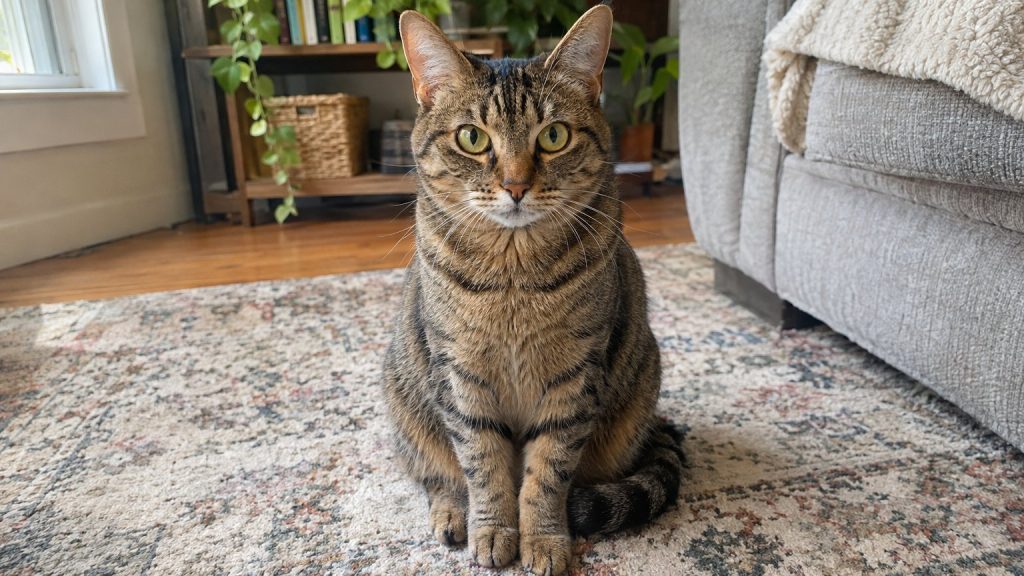
You look up from your phone and there they are, sitting perfectly still and watching you. No meow, no movement, just eyes. Why does my cat stare at me? Most of the time the answer is harmless, and often it’s a compliment. The trick is to read the rest of the cat.
Cats Didn’t Start Out Staring at Us
Cats Protection, the UK cat charity, points out that cats are a solitary species. They don’t naturally need to hold eye contact with each other to get a message across. So where does all the staring come from?
Partly from us. If your cat stared at you once and you answered with food or a fuss, they learned that eye contact gets results. Every time it works, the habit gets stronger. Cats Protection says meowing developed in a similar way, because it works so well on people.
It’s also a sign of a close bond. According to the charity, a cat is unlikely to hold eye contact with someone they don’t like or trust.
Six Stares, Six Messages
Dr. Wailani Sung, a veterinary behaviorist writing for PetMD, describes the most common reasons a cat stares at a person. The eyes start the message, and the body finishes it.
“Feed me”
Some cats stare at their people around mealtime. Once you look back, they may meow, rub against you, or walk off toward the food bowl. Others simply watch you eat, hoping for a share.
“Notice me”
An attention stare often turns into a slow blink, a meow, or a roll onto the side as soon as you make eye contact. It’s an invitation, and it’s fine to accept it.
“Let’s play”
Crouched low, pupils wide, tail swishing from side to side. Dr. Sung says this cat may sprint toward you and swat at your feet, or veer off at the last moment. A wand toy is the best answer, before your ankles become the toy.
“I love you”
Soft eyes and slow blinks mean your cat feels safe enough to close their eyes around you. You can answer with a slow blink of your own. Our guide to the slow blink shows you how.
“Something scared me”
A frightened cat keeps their eyes fixed on whatever worried them. Other signs include wide pupils, a lowered head, ears turned to the side or back, a crouched body, and fur standing up.
“Back off”
A hard, unblinking stare with a stiff body and raised fur along the back and tail is a warning. The cat wants distance, and moving closer can end in an attack.
How to Respond
Look at the whole cat before you react. Ears, pupils, tail, and posture tell you which stare you’re getting.
- Relaxed, curious, or chatty: go ahead and engage. Talk to them, play, or slow blink back.
- Crouched and wiggling: it’s playtime. Bring out a toy they can chase.
- Tense, puffed up, or hissing: look away, stay still, and step back. Dr. Sung suggests waiting until you’re at least 5 feet away, then tossing a toy to the other side of the room to change the mood. Don’t try to pet or talk to the cat until they’ve settled.
When a Stare Is Worth a Vet Visit
Staring is usually nothing to worry about. Cats Protection suggests mentioning it to your vet if your cat has only recently started, so they can rule out a medical cause. In older cats, staring can be a sign of sight loss, so get them checked as soon as possible.
The same goes for a stare that comes with other changes, like hiding, eating less, or acting unusually tired. PetMD advises calling your vet whenever staring is paired with a change in behavior or signs of illness.
Most of the time, though, a staring cat is simply a cat who has learned that you’re worth watching. And quite possibly that dinner is late.