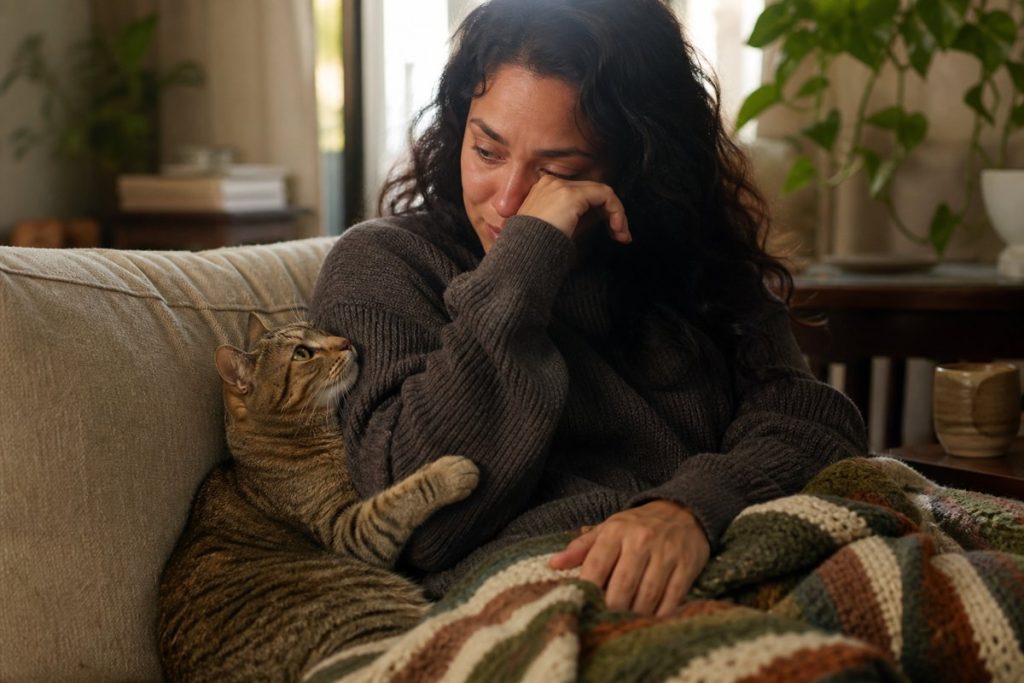
Plenty of people cry on the sofa and, a minute later, find a cat pressed against their hip. The question is always the same. Why does my cat comfort me when I’m sad? Maybe they clocked the mood. Maybe they wanted a lap that had stopped moving.
They will not sit you down and ask what happened. They notice that something in you has changed: face, voice, posture, even scent. A lot of them move toward that change.
Do cats actually know when you’re sad?
They notice that you are not yourself, even if they have no human story for why.
Nobody has put a crying owner in a lab and proven cats understand why you’re crying. The evidence we do have still beats folklore. Cats can tell human expressions and sounds apart. They react differently to good versus bad human signals, and they form real attachment bonds with the people they live with.
In 2020, Quaranta, d’Ingeo, Amoruso, and Siniscalchi at the University of Bari played recordings of human laughter and angry growls while showing cats two photos: a happy face and an angry face. The cats looked longer at the matching face, and showed more stress-related behavior during the anger pair. Ten household cats, tested at home. Small study, and still a useful one: cats have a working picture of human emotion, beyond a reaction to loud noise. (Paper on PMC)
The Bari cats were matching a face to a sound. Last night’s argument sits outside that experiment. Sadness still lives in a nearby cluster of cues: a quieter voice, a changed face, hands that have stopped doing the usual things.
Galvan and Vonk (Oakland University, 2016) found a more modest version of the same idea. Cats stayed closer and looked more relaxed when their owner looked happy rather than angry. A stranger’s face did less. They are reading you, specifically.
Your face, your voice, and your scent
Crying rearranges more than your expression. Breathing changes with it. You talk less, or the voice thins out. You smell different, too. Stress sweat is not gym sweat.
In 2023, d’Ingeo and colleagues at Bari gave 22 pet cats cotton swabs of human underarm odor collected during fear, happiness, exercise, and a neutral showered state. Cats showed more severe stress-related behavior to the fear smell than to the neutral or exercise smells. The exercise samples matter here, because they rule out a simple reaction to a person who had been moving around. (Scientific Reports)
That study used fear, not tears. Don’t turn it into a claim that cats smell sadness on a molecular level. What you can actually use is smaller: your cat’s nose is in the conversation.
Voice matters too. Crying, sniffling, a cracked “hey, buddy”: unusual sounds in a quieter house. Some cats come in to investigate. Some leave, and that is also a response.
They use you as a safe place
Oregon State University’s Human-Animal Interaction Lab ran the test that dented the “cats don’t care” argument.
Kristyn Vitale, Alexandra Behnke, and Monique Udell put cats through a Secure Base Test: two minutes with their person in a new room, two minutes alone, two minutes of reunion. Same logic used with infants and with dogs. Of the kittens they could classify, 64.3% were securely attached. Of the adults, 65.8%. That is almost the split you see in human babies. Secure cats settled when their person came back and went back to exploring. Insecure cats hid, clung, or stayed away. (Oregon State; Current Biology, 2019)
Vitale’s line is the one to keep: most cats use their owner as a source of security. The aloof-cat myth is describing a minority style. On a hard day you go still, and for a securely attached cat that quiet landmark reads as an invitation.
There is older work on mood. In 1999, Rieger and Turner watched people who lived alone with a cat. More depressed owners started fewer “intents” to interact, but once the cat was around they started more, a kind of social pacemaker. Cats also did more head- and flank-rubbing toward more depressed people. Owners whose cats went along with those bids felt less depressed after two hours. (Anthrozoös) A later paper from the same group found cats eased negative mood about as much as a human partner, without boosting positive mood the way a partner can.
Some of the most glued-on lap cats are the ones who had a rough start. A cat who has learned that one person is safety will treat that person like a landmark.
The chemistry of a lap cat
People like to say cats have a “cuddle hormone.” The published data is narrower than the slogan.
In dogs, Miho Nagasawa and colleagues showed a loop: dogs who gazed longer at their owners had higher oxytocin, and so did the owners. That 2015 Science paper is about dogs, not cats. The finding gets copy-pasted onto every species with fur. (Science)
Cats have their own numbers now. Takumi Nagasawa, Ohta, and Uchiyama (2022) collected urine from 49 house cats. Owners who talked to and petted their cats more often had cats with higher urinary oxytocin. Cortisol, the stress marker, did not show a tidy pattern. (Animals)
In 2024, Hattori, Kinoshita, Saito, and Yamamoto gave 30 cats oxytocin or saline through a nebulizer. Male cats looked at people longer afterward. Females did not show the same gaze bump, and unlike dogs the extra looking was not reserved for the owner. (Scientific Reports)
On your side of the lap, touch is doing real work. In a Washington State University trial (Pendry and Vandagriff, 2019), 249 students got 10 minutes of hands-on time with shelter cats and dogs, or they watched other people pet, looked at photos, or waited. Only the students who actually put their hands on an animal had lower salivary cortisol afterward. (WSU news)
On a bad day the loop is ordinary. You sit still long enough for the cat to arrive, you put a hand on them, and their oxytocin is already in play while your stress hormone drops a notch.
Cats purr when they are content, and they also purr when they are hurt or scared. People feel calmer next to the sound, which is a good reason to like it. Skip the internet claim that a purr knits bones. That grew out of a 2001 conference abstract, not a trial of a cat on your lap.
Why some cats come closer (and why others leave)
When you’re sad you change shape in the room. You go still and stay warm, and your hands slow down. Curious cats come to look. Social cats answer when you talk or reach.
Some of what looks like comfort is cat-to-cat social behavior aimed at a person. Head-bunting and flank-rubbing smear scent and mark you as part of the group. Kneading is leftover kitten behavior. Sitting on your chest puts them on the warmest, loudest part of you.
Slow blinking is the one signal we can name with a lab behind it. Humphrey, Proops, Forman, Spooner, and McComb at the University of Sussex (2020) found that cats half-blink and narrow their eyes more when a person slow-blinks at them. They are also more willing to approach a stranger who just did it than one with a blank face. (Scientific Reports)
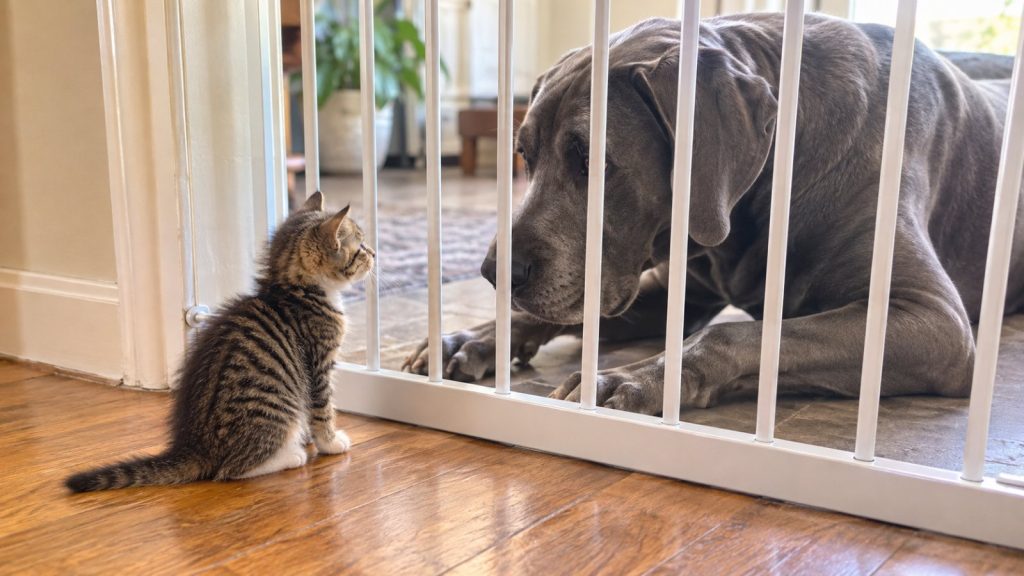
Then there are the cats who leave. Wet faces, odd sounds, and extra reaching can be a lot. Insecure-avoidant cats in Vitale’s work moved away under stress. Leave the door open. Let them take the back of the sofa instead of your ribs. Sitting three feet away is still being in the room.
And some cats skip the hug and bring a toy, a cricket, or the 11 p.m. zoomies. Play is one of the few things they can offer that changes their own state. If they dump a mouse on your foot, they are using the toolkit they have. Better indoor options exist.
How to meet them halfway
You do not need a script.
Let them choose the distance. Open a lap if you want, and don’t scoop a cat who is only hovering. Hovering already counts as the visit.
Slow blink instead of staring. A long, wet-eyed stare is intense, so soften it. If they blink back, that was a conversation.
Hands first, face second. Many cats prefer a cheek or shoulder to a hug around the ribs, especially if you are shaking.
Talk in the voice they already know. Their name, said quietly, is enough. Keep feeding time, litter, and the patch of sun the same.
If you are not okay, get a human too. A cat can take the edge off a hard evening. They cannot treat depression, grief, or a crisis. If the sad days are stacking up, talk to a person whose job is that.
A lot of us keep cats because the house feels less sharp with them in it. They are family who happen to be very good at sitting close, on the nights when sitting close is the thing you can stand.
Next time they come over, you can skip the debate about whether they really understand. They noticed you, and they stayed.
FAQ
Do cats know when you’re crying?
They notice the package of cues that come with crying: a different face, a different voice, less movement, sometimes a different scent. The 2020 Bari study showed cats match happy and angry faces to the matching sounds, and they get more stressed by anger.
Why does my cat comfort me when I’m sad?
You are warm and still, and you are available. For a securely attached cat (about two-thirds of cats in the Oregon State study), you are also the safe person. Sitting on you combines heat, scent-sharing, and attachment in one loaf.
Is my cat comforting me or just wanting attention?
Both can be true in the same minute. Rieger and Turner found cats rubbed more on more depressed owners, and owners whose cats played along felt better afterward. Your cat may also want a lap. Those motives can sit next to each other.
What if my cat leaves when I cry?
Some cats find crying loud and wet, and the whole scene feels strange. Let them pick a nearby perch. Try a slow blink from a few feet away instead of a scoop. A cat who sits in the doorway is still in the room with you.