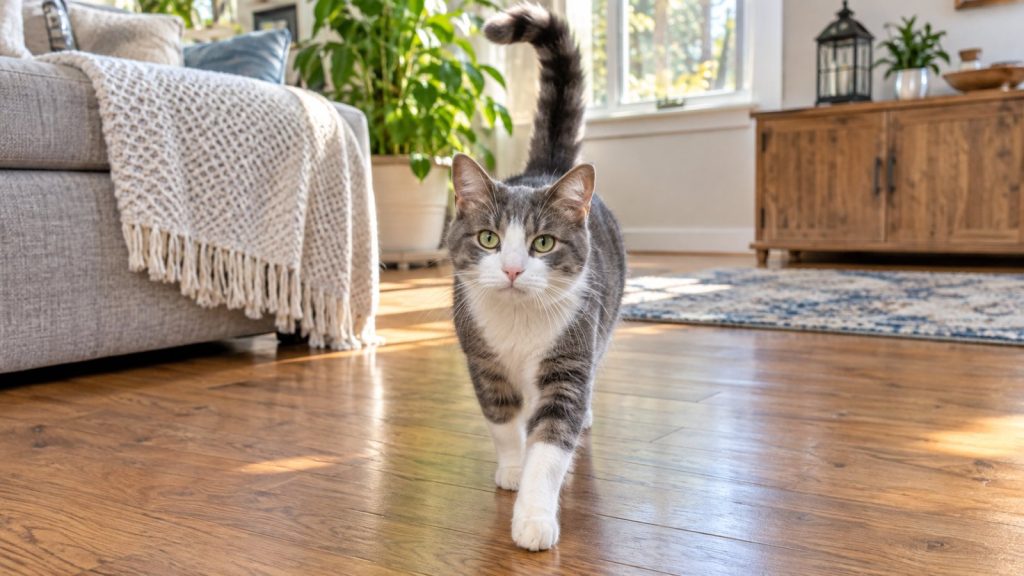
Cats can’t tell you how they feel, but their tails come close. A cat’s tail has 18 to 23 small bones that link like a chain, according to Live Science, so it can move in almost any direction and change in an instant. Learning cat tail language is one of the easiest ways to understand the animal you live with.
The Quick Guide
Straight up
A friendly hello. Animal behaviorist Mikel Delgado of Purdue University says that a tail pointing up signals a social approach. This one seems to be special to pet cats: one study found that wild cats didn’t use it, which suggests that it developed as cats became domesticated.
Up and quivering
Usually excitement, the kind you might see when you walk through the door or pick up the food bag.
Puffed up like a bottle brush
A response to a threat, such as spotting a strange cat outside. Tiny muscles at the base of the hairs make the fur stand on end, much like goosebumps in people, and it makes the cat look bigger. Give them space.
Held low
Generally a sign of fear. The cat is trying to look smaller and protect themselves.
Tucked under or wrapped around the body
A frightened cat may do this. But context matters, because a cat curled up and resting may wrap their tail around themselves just to get comfortable.
Thrashing or slapping
Moving fast from side to side, or slapping the ground, can mean your cat is angry. This is a good moment to stop petting and step back.
Read The Whole Cat
A tail is only one part of the message. Experts say that cats use their eyes, ears, body, and tail together to show how they feel. Researchers have also found that when cats interact with each other, they tend to keep their tails down and rely more on their ears.
So before you decide what a tail means, look at the rest of the picture:
- Ears: forward and relaxed is good. Flat or turned back means trouble.
- Eyes: soft or half closed is calm. Wide and staring means your cat is on alert.
- Body: loose is happy. Crouched or stiff means worried.
- Situation: a flicking tail during play means something different than during a vet visit.
Putting It To Use
Tail signals are most useful when you’re petting your cat. A tail that starts to flick is one of the warnings that often comes before a sudden bite, so you have time to stop.
They’re also useful when you’re introducing a new pet. Tails up on both sides is a great sign. A puffed or low tail means slow down and try again later.
If your cat’s tail hangs limp, or your cat reacts as if touching it hurts, ask your vet to take a look.