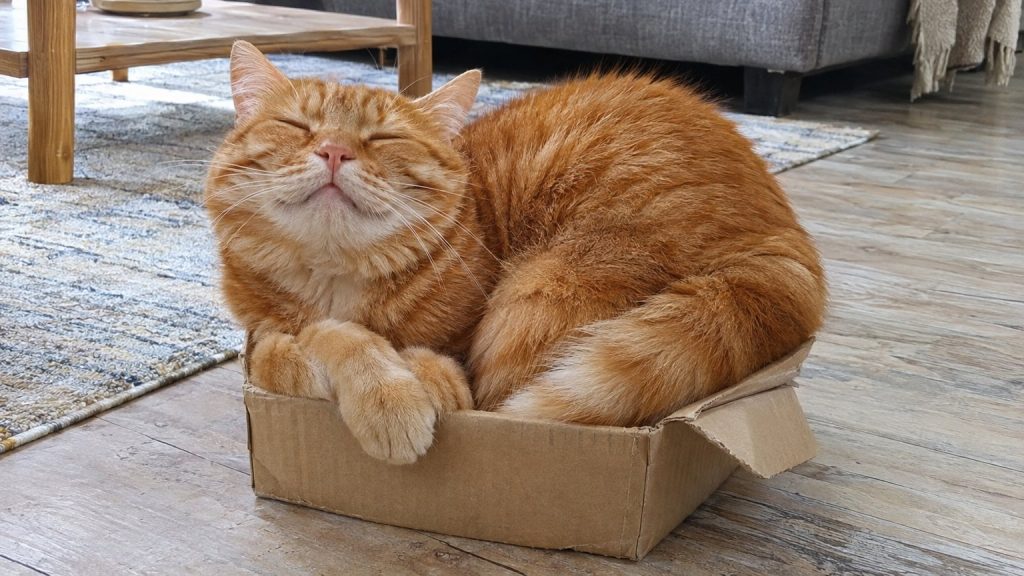
You spend weeks choosing a cat bed. It arrives in a box. The bed sits untouched in the corner, and the cat moves into the box that same evening.
Every cat home has a version of this story. The laundry basket, the open suitcase, the bathroom sink, the shoebox that is clearly two sizes too small. So why do cats love boxes this much? The answer turns out to be less about the box and more about how a cat sees the world.
A Small Space Feels Safe
Nicholas Dodman, professor emeritus of animal behavior at Tufts University’s Cummings School of Veterinary Medicine, spent years answering this exact question as a TV panelist. Writing for The Conversation, he said every case had the same explanation: cats like to squeeze into small spaces because they feel safer and more secure there.
Open rooms are noisy and exposed. A box has walls on every side, one way in, and a clear view of anyone coming. For an animal that hunts small prey but is also small enough to be someone else’s prey, that is a very comfortable place to sit.
Shelter Cats Settled Faster With a Box
This is not just a cute internet theory. Dutch researchers gave newly arrived shelter cats a box to hide in and compared them with cats who had none. The cats with boxes adapted to their new home more quickly and showed less stress.
The idea kept growing. In 2025, Ruth van der Leij completed her PhD at Utrecht University on stress in shelter cats, and Utrecht University reports that simple hiding places lowered it. The university’s veterinary faculty now uses shelter boxes for the cats in its care, and the Dutch Animal Protection Society added them to its shelter guidelines.
If a plain cardboard box can calm a scared cat in a noisy shelter, it is easy to see why your cat claims every box that comes through the door.
A Bit Like Being Swaddled
Dodman also points back to kittenhood. Young kittens sleep pressed against their mother and littermates, warm and surrounded. A snug box gives that same all-around contact.
He believes this close pressure may release endorphins, the body’s natural feel-good chemicals. He has studied the calming effect of gentle side pressure, together with Temple Grandin, but for cats in boxes it is still his theory rather than a proven fact. It would explain why the tightest box always seems to win, though.
Even a Square of Tape Works
In 2017, cat owners online started marking squares of tape on the floor. Cat after cat walked over and sat right in the middle.
Dodman called it a “virtual box”. It has no walls, so it is a poor substitute for the real thing, but it may still give a cat a little of that same feeling of having a space of their own.
How to Use This at Home
You do not need to buy anything special. A few ideas based on van der Leij’s shelter advice:
- Give your cat at least one hiding place they can reach any time, like a box on its side or a covered bed.
- Offer one up high too. Dodman says raised hideaways are even better, because cats like a safe view from above.
- Keep food, water and the litter box in the same places, so home feels predictable.
- Let your cat decide. If they choose to hide, leave them be and let them come out on their own.
The one exception is the cat carrier. It is a small enclosed box, yet most cats hate it, because it usually means a car ride and a vet visit. Leaving the carrier out with a soft blanket inside, so it becomes just another hiding place, can help.
A Box Is Never Just a Box
So the next time your cat ignores the expensive bed for the box it came in, take it as information. Your cat is telling you what makes them feel safe, and it is very cheap to give.
If you liked this one, you might also enjoy why your cat takes over your laptop and why so many cats choose to sleep on you.