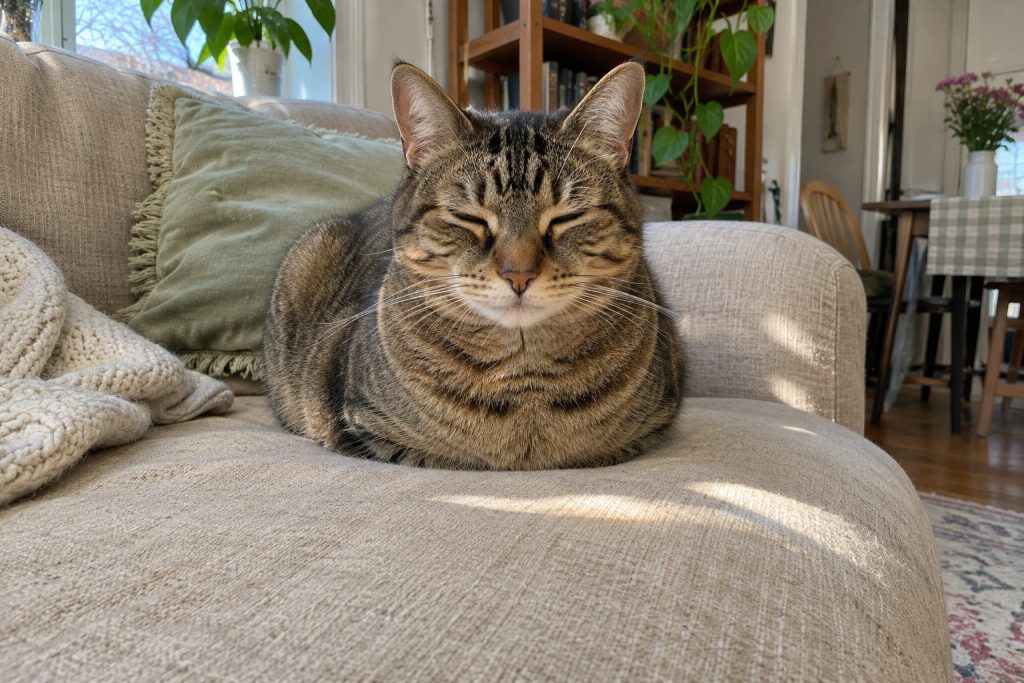
At breakfast, there’s a neat little loaf on the sofa. By lunch, the same cat is belly-up in a rectangle of sun. When the light moves off the rug, a tight ball takes its place, tail wrapped cleanly over the nose like a croissant.
Cat sleeping positions give you quick clues about how warm, comfortable, and safe your cat feels where they’ve settled. The room temperature, the spot they picked, and what is normal for your cat all shape what each pose means.
The loaf
In a classic loaf, the front paws fold under the chest, the back legs tuck close to the body, and the head stays upright. You’ve probably seen your cat drift off like this beside you on the couch, only to crack one eye open the second a snack bag crinkles.
Cats Protection’s guide to sleeping positions notes that the loaf is a common, relaxed posture when a cat feels comfortable. Tucking the paws underneath also traps body heat, and because those legs are folded away, a loafing cat isn’t coiled for an instant escape. Soft eyes, loose whiskers, and slow breathing tell you they’re simply taking an easy break.
Watch for the look-alike, though. A cat who sits tightly hunched with a lowered head, tense muscles, and little interest in moving may be in discomfort rather than resting. If that posture is new for your cat, especially alongside less eating or unusual hiding, call your vet.
The croissant curl
A croissant starts with the spine curved around the paws. Pull the tail over the face and you get a full circle. Tucked-in limbs hold onto warmth, which is why tight curls show up more often when the house cools down at night or a draft hits the floor.
Plenty of cats curl up even in a warm room simply because it feels cozy and protected. Notice where they choose to settle, too. A tight curl pressed against your legs gives them warmth and company at the same time, which is a big part of why so many cats sleep on their people.
The belly-up sprawl
When a cat flops onto their back with loose paws and their stomach facing the ceiling, they’re leaving their most vulnerable area uncovered. In a familiar room with soft breathing and relaxed limbs, that’s a strong sign they trust their surroundings. Spreading out also lets extra heat escape, so a sunny afternoon often brings out the belly-up nap.
Still, an exposed stomach during a nap is best admired from a distance. If you’ve ever reached down for a rub and met four paws at once, our guide to what a cat’s exposed belly really means explains how to read the signs when they’re awake.
The sploot
The sploot happens belly-down, with one or both hind legs stretched straight behind the body (a full sploot, half sploot, or side sploot). Front paws might reach forward or stay tucked under the chin. It’s the pose that makes a cat on the kitchen floor look twice as long as usual.
VCA Animal Hospitals’ guide to splooting explains that it’s both a comfortable stretch for the back and hips and a handy way to cool down when their belly rests on cool tile or hardwood. Pay attention only if a cat suddenly starts resting this way and seems stiff or slow when standing back up, since joint pain is worth checking with your vet.
Your cat’s usual routine tells you the most
The clearest clue is what happens before and after the nap. A cat who sploots after a burst of play and then trots smoothly toward dinner is doing something very different from a cat who stays curled in one corner and skips the things they normally love.
Give your cat a few choices around the house: a soft blanket in a quiet corner, a sunny perch, and a cool patch of bare floor. Watch where they land as the day warms up and cools down. Within a few days, you’ll know which poses belong to the weather, which belong to trust, and which are just your cat’s favorite way to nap.
Sources
- Cats Protection, What do cat sleeping positions mean?, Cats Protection Blog, 2026.
- VCA Animal Hospitals, What is a sploot, and why does my pet do it?, VCA Animal Hospitals.